Industrial Engineer Salary: Entry-Level vs. Experienced Pay

See if you qualify for training programs
Answer a few questions in 2 minutes. Free, no commitment.
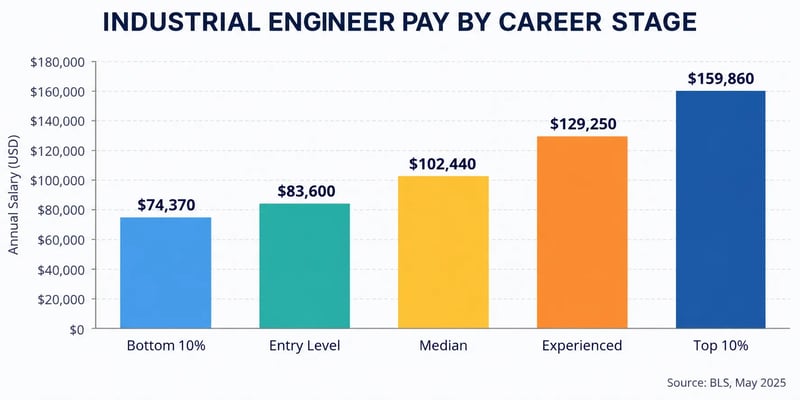
Industrial engineers earn a median of $102,440 a year, or $49.25 an hour, according to the Bureau of Labor Statistics (May 2025, the newest wage data available). That single number hides a wide spread. An entry-level industrial engineer typically starts near $83,600, the BLS 25th percentile, while an experienced industrial engineer earns $129,250 or more at the 75th percentile, and the top 10% clear $159,860.
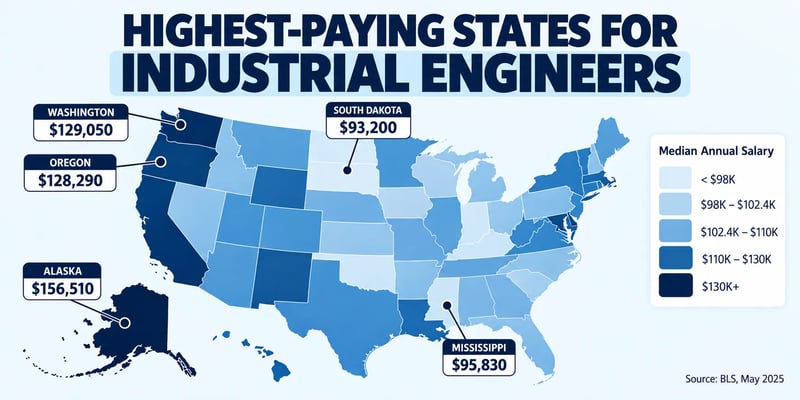
Location moves the number almost as much as experience does, since Alaska's median is $156,510 and South Dakota's is $93,200. The gap between entry-level and experienced pay works out to about $45,650 a year, and industry, specialization, credentials, and leadership decide how fast you close it.
Industrial Engineer Salary by Industry
Where you work shapes your pay. These are the five largest employing industries for industrial engineers, with BLS median wages for May 2025.
Industry | Median pay | Share of industrial engineer jobs |
|---|---|---|
Professional, scientific, and technical services | $107,610 | 14% |
Computer and electronic product manufacturing | $105,370 | 11% |
Transportation equipment manufacturing | $102,390 | 15% |
Machinery manufacturing | $99,070 | 8% |
Fabricated metal product manufacturing | $93,170 | 6% |
Professional, scientific, and technical services, which includes consulting and engineering services, leads the group at $107,610. Transportation equipment manufacturing, which includes automotive and aerospace, employs the largest share of industrial engineers at 15%. Fabricated metal product manufacturing pays about $14,000 less than consulting and engineering services at the median, so if pay is the priority, consulting, electronics, and transportation equipment are strong places to start.
Industrial Engineer Salary by Specialization
BLS reports one wage for the whole occupation, so specialization affects pay through the industry and employer you land in rather than through a separate official figure. O*NET, the Department of Labor's occupation database, breaks industrial engineering into three specializations, and the job titles under each show where the work leads.
Specialization | What they do |
|---|---|
Manufacturing engineers | Design, integrate, or improve manufacturing systems and related processes. Common titles: manufacturing engineer, process engineer, plant engineer, process improvement engineer |
Validation engineers | Design or plan protocols so equipment and processes meet purity, safety, and quality requirements. Common titles: quality engineer, reliability engineer, supplier quality engineer, validation specialist |
Human factors engineers and ergonomists | Design objects, facilities, and environments that improve human well-being and system performance. Common titles: human factors engineer, ergonomist, cognitive engineer |
Supply chain and logistics work is a fourth common direction, and a supply chain management degree can lead there directly. Specializing early in a high-demand area such as automation, data analytics, or regulated manufacturing can help you reach the 75th percentile faster.
Education, Licenses, and Certifications That Affect Pay
Bachelor's Degree
BLS lists a bachelor's degree as the typical entry-level education. Most industrial engineers hold a degree in industrial engineering, while others come from mechanical, electrical, or general engineering. High school students interested in this career should take strong math, computer science, and science courses, and the guide to earning a bachelor's degree in engineering covers the admission and coursework path.
Master's Degree
Some universities offer five-year programs that lead to both a bachelor's and a master's degree. A master's can help if you want to move into operations research, analytics, or leadership, but BLS lists no separate wage for it, and strong pay does not require one.
FE Exam and PE License
The FE exam is the first step toward licensure, and the PE license adds the authority to sign off on projects, with a value that depends heavily on your industry.
Lean Six Sigma, Supply Chain, and Project Management Credentials
BLS notes that certification is not required but that some industrial engineers choose to earn a professional credential. Credentials in lean, Six Sigma, supply chain, and project management make you more competitive and give you a stronger position in salary discussions. For engineers who want to run projects full time, the path to becoming a technical project manager builds on the same skills.
Industrial Engineer Salary vs. Related Careers
Occupation | Median pay (BLS, May 2025) | Typical education |
|---|---|---|
Architectural and engineering managers | $171,270 | Bachelor's degree |
Industrial production managers | $126,060 | Bachelor's degree |
Health and safety engineers | $115,160 | Bachelor's degree |
Industrial engineers | $102,440 | Bachelor's degree |
Management analysts | $101,860 | Bachelor's degree |
Logisticians | $82,320 | Bachelor's degree |
Cost estimators | $78,740 | Bachelor's degree |
Industrial engineering technologists and technicians | $66,120 | Associate's degree |
Industrial engineers earn more than logisticians and cost estimators, and about the same as management analysts. The clearest way to earn more is to move into management or a related engineering specialty such as health and safety engineering. If a four-year engineering degree is not the plan, manufacturing engineering technology programs lead to the technologist and technician roles at the bottom of the table, which start with a two-year degree.
How to Move From Entry-Level to Experienced Pay Faster
- Choose high-paying industries early. Start where pay and demand are strong: consulting, electronics, transportation equipment, aerospace, and regulated manufacturing. The industry you enter at the start of your career often shapes your pay for years.
- Build data, automation, and lean skills. Employers value engineers who can analyze data, use simulation and modeling tools, and lead process improvement efforts. BLS highlights computer skills, math skills, and problem-solving among the qualities that matter most.
- Earn credentials that employers reward. Pursue lean or Six Sigma credentials early and consider the FE exam while your coursework is fresh. Add supply chain or project management credentials if you move toward operations.
- Take on project leadership. Leading a project that saves money or raises output is the clearest proof you are ready for senior pay and a team lead role.
- Consider a strategic job change. Changing employers can reset your pay to current market rates, while internal promotions can bring added responsibility and stability. Weigh both, and avoid staying too long at a company that pays below the market for your skill level.
- Negotiate from the data. Anchor your request to the BLS percentile for your state and industry, and ask about base pay, bonuses, relocation help, tuition support, and licensing or exam fees. A competing offer or a recent certification strengthens your position.
- Relocate strategically. Moving to a higher-paying state or a strong manufacturing hub can raise your salary quickly, as long as the pay increase outruns the change in housing and living costs.
Job Outlook and Salary Trends for 2027
Indicator | Value |
|---|---|
Employment in 2025 | 365,100 |
Projected employment in 2035 | 410,600 |
Projected growth, 2025 to 2035 | 12% (45,400 jobs) |
Average growth for all occupations | 3% |
Projected annual openings | About 23,100 |
BLS describes this growth as much faster than average. Many openings come from workers who retire, change careers, or move into other occupations, which creates steady demand even outside growth. Demand is expected to rise as companies look to lower costs, because industrial engineers are valued for streamlining production, managing supply chains and logistics, and bringing automation skills. They also work in consulting, engineering services, and research and development firms, which broadens the job market.
AI and automation are reshaping how factories, warehouses, and hospitals operate, and industrial engineers are the people who design and improve those systems. For most engineers, these tools shift the work toward data analysis, systems design, and process improvement rather than replacing the role, and engineers who build skills in analytics, automation, and digital tools are well positioned for higher pay. BLS updates these wages every spring, so expect the next release, covering May 2026, to refresh every figure above.
Frequently Asked Questions
How much do industrial engineers make a year?
The median industrial engineer salary is $102,440 a year, or $49.25 an hour, according to BLS data for May 2025. Half of industrial engineers earn more than that and half earn less. The middle 50% earn between $83,600 and $129,250, and the top 10% earn more than $159,860.
What is the starting salary for an industrial engineering graduate?
A new graduate typically starts between about $70,000 and $94,500 in most postings, with ZipRecruiter's entry-level average at $83,498 and the BLS 25th percentile at $83,600. Starting pay runs highest in Alaska, Washington, Oregon, Delaware, and California, where the 25th percentile is close to or above $100,000.
How much more do experienced industrial engineers earn than entry level?
Using BLS percentiles, experienced pay of $129,250 is about $45,650 higher, or roughly 55% more, than entry-level pay of $83,600. Engineers who move into management can add more: industrial production managers earn a median of $126,060, and architectural and engineering managers earn $171,270.
What is the highest salary an industrial engineer can make?
The top 10% of industrial engineers earn more than $159,860 nationally, and the 75th percentile in Alaska reaches $186,790. Beyond that, pay comes from management, where architectural and engineering managers earn a median of $171,270, or from specialist roles in high-paying industries and metro areas such as Anchorage.
Is industrial engineering a good career in 2027?
Yes. BLS projects 12% employment growth from 2025 to 2035, much faster than the 3% average for all occupations, with about 23,100 openings a year. The median pay of $102,440 is about double the median for all U.S. workers, and demand is tied to cost reduction, supply chains, and automation.
How long does it take to reach a six-figure salary?
The national median is above $100,000, and many engineers reach that level around mid-career, roughly 5 to 10 years in. In high-paying states such as Alaska, Washington, and Oregon, the 25th percentile is already close to or above $100,000, so early-career engineers there can cross six figures within their first few years.
Planning Your Industrial Engineer Salary Path
The path from entry-level to experienced industrial engineer pay is shaped by far more than years on the job. State, industry, specialization, credentials, and leadership each move the number, and the engineers who reach the 75th percentile fastest usually pull two or three of those levers at once rather than waiting for seniority.
If you are planning your next move, compare your offer against the state and industry figures above, pick a specialization with strong demand, and decide on your next credential or leadership step before your next review. With 12% projected growth and about 23,100 openings a year, the demand side is already working in your favor.